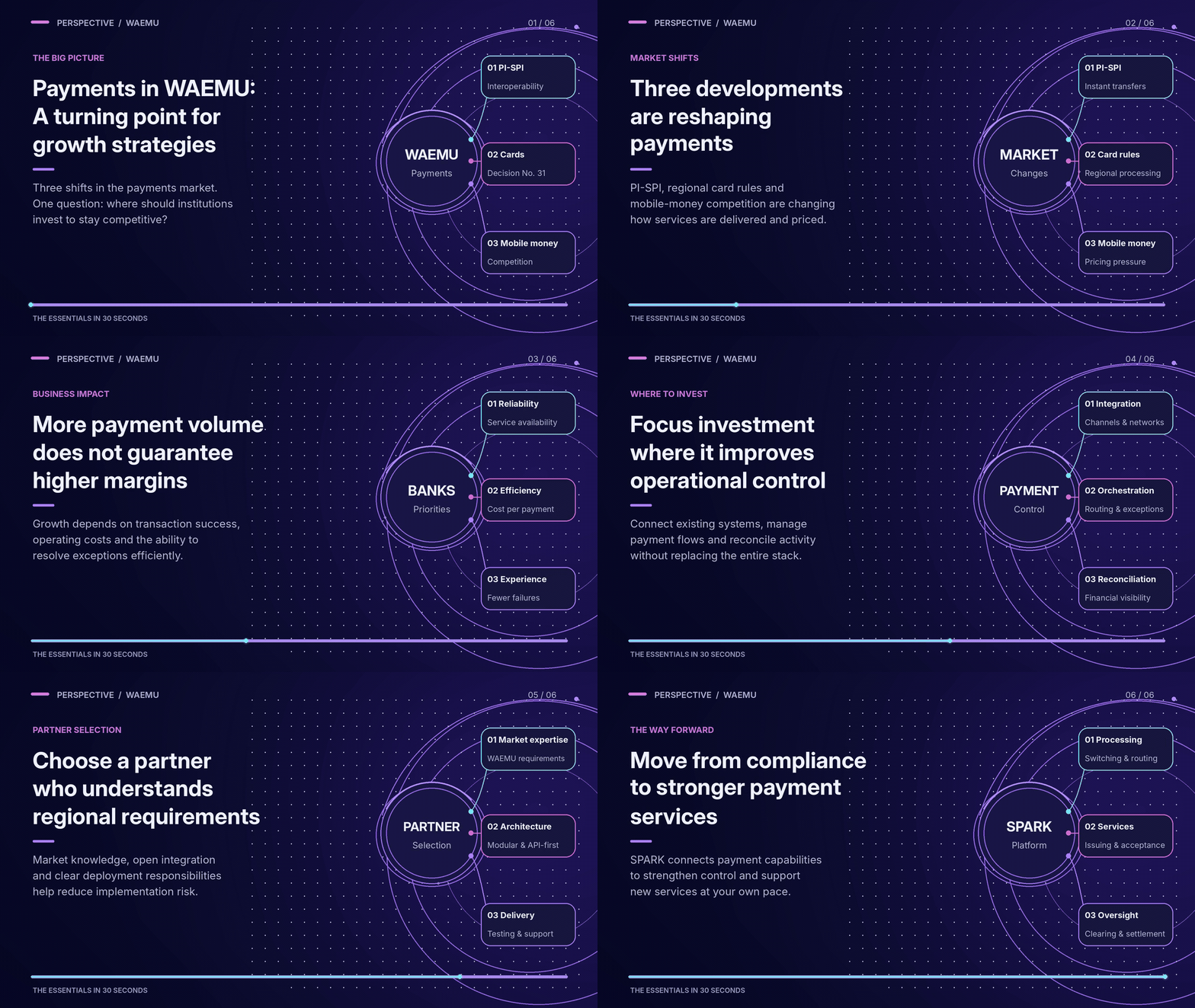
Since November 2, 2026, interoperable e-money transactions in the WAEMU have been routed through PI-SPI. Small domestic person-to-person transfers are free, subject to conditions. At the same time, Decision No. 31 now also applies to e-commerce and to international scheme cards.
For heads of payments, three questions matter most. What is the full cost of a completed payment? What share of incidents needs manual intervention? How long does it take to roll out a new feature?

1. Three BCEAO changes that affect payment profitability
• The Interoperable Platform of the Instant Payment System (PI-SPI), launched in September 2025, has been the mandatory channel for interoperable e-money transactions since November 2, 2026. Domestic transfers are subject to regulated pricing terms, and these will extend to cross-border transfers on June 1, 2027. Approved Business APIs also support bulk payments and collections for companies.
• Decision No. 31 extends regional routing to e-commerce transactions, including those made with cards issued under international schemes. Issuers and acquirers need to adapt their routing rules, authentication mechanisms, and clearing and reconciliation processes, while keeping the customer’s payment journey uninterrupted.
• Margins under pressure, some transfers are now free, and pricing is regulated, which changes the economics of payments. In markets where transfer fees were high, the business model has to be rethought. Elsewhere, competition is moving toward differentiated payment offers. In both cases, handling more volume does not guarantee better profitability. Banks also need to control the full cost of each transaction.

2. When access is the same for everyone, how do banks and payment institutions stand out?
Interoperability puts all participants on equal footing on one point: each can send funds to any other and receive funds from any other. It says nothing about how each institution handles those flows internally. That is where the gaps appear, and they can be measured.
Take a bank that has connected its mobile app to PI-SPI. The instant transfer may work on the customer side, but operational tracking can remain split between the channel, the platform connection module, and the core banking system. When a confirmation arrives late or the network drops, teams must cross-check several logs to determine the transaction’s actual status, confirm the debit, and correct any accounting discrepancies. This gap between technical execution and financial control leads to manual interventions, customer complaints and extra costs, which weigh most heavily on free transfers.
3. Business APIs, e-commerce acquiring and configurable routing: what each offer requires technically
Building a corporate offer on the PI-SPI Business APIs means securing the interfaces, handling bulk payments, passing on statuses in real time and reconciling collections. Without reusable components, every new client becomes a custom integration project.
For e-commerce acquiring, Decision No. 31 requires banks to identify cards issued within the Union, apply the right routing and reconcile files from the different parties involved. When these rules are hardcoded in a legacy switch, every regulatory change calls for extensive development and testing. Configurable rules shorten those lead times. Instant payments also need fraud controls built in before execution, without breaking real-time processing.
4. Prioritizing software investments without replacing everything
Few institutions can modernise their switch, card management system, acquiring and reconciliation at the same time. For heads of payments, the real question is the order of the projects.
Four criteria help decide:
• The regulatory deadline that applies to the institution
• The expected business value.
• The technical dependencies between components
• The current operational workload
A modular architecture makes it possible to replace or add a component while keeping those that work well. Integration is still needed, but its scope is known in advance, and the risks are easier to contain.
A few indicators are enough to steer these decisions:
• Full cost per completed payment
• Share of transactions processed without manual intervention
• Reconciliation exception rate and average time to resolve an open item
• Service availability, 24/7
• Time to market for a new payment offer
Measured before a payment modernisation project starts, they allow its results to be assessed objectively.
5. What a payments software partner needs to demonstrate in the WAEMU context
Knowing the WAEMU market goes beyond mastering the regulatory requirements. A software partner has to understand the specifics of regional infrastructure, anticipate integration constraints and support institutions as their payment systems evolve.
Beyond compliance with PI-SPI, Decision No. 31 and scheme rules, the choice of a partner should meet four requirements:
• Regional market expertise: an understanding of BCEAO requirements and of the rules for routing, clearing and settlement, and the ability to turn them into reliable operational processes.
• Integration with existing infrastructure: the ability to connect banking systems, switches and the various payment channels, while keeping responsibilities, timelines and deployment risks under control.
• Reliable, well-controlled operations: handling of failed transactions, duplicates and incidents, automated reconciliation, and visibility across the whole processing cycle.
• Scalability and long-term support: building in future regional requirements, adapting processing rules and rolling out new payment offers quickly without disrupting existing infrastructure.
6. The MS Solutions Group approach with the SPARK platform
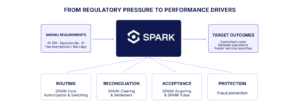
With the new PI-SPI and Decision No. 31 requirements, banks need to be able to change how they operate without losing control of costs or disrupting the infrastructure they already have.
This is the thinking behind SPARK, the modular platform from MS Solutions Group. It covers issuing, acquiring and acceptance, switching, fraud prevention, clearing and settlement. Its open, interoperable architecture lets institutions strengthen the capabilities that match their priorities, without requiring them to replace existing systems that already meet their needs.
SPARK Core Authorisation and Switching lets banks adapt routing strategies through configurable rules, with visibility of transaction status and journey. This supports the orchestration of flows and the adjustment of processing to the requirements of different payment networks and infrastructures.
SPARK Clearing & Settlement supports the same objective. It automates reconciliation between switch logs, scheme data and core banking entries, and it processes settlement files. The aim is to reduce manual intervention, make discrepancies easier to identify and keep better control of the costs of clearing and settlement operations.
Conclusion: payment margins will be decided by operations and cost per transaction
Compliance with BCEAO rules is now a prerequisite, but it will not be enough to protect margins. What sets banks apart will be their ability to process flows at a controlled cost, reduce exceptions and roll out collection and payment offers for businesses and merchants more quickly.
Investments should therefore be judged by what they contribute to operational efficiency, control of cost per transaction and the development of new offers.