Angola’s Payment Modernisation: What Kwanza Settlement in SADC-RTGS Means for Banks
On 27 July 2026, the South African Reserve Bank and Banco Nacional de Angola formally announced the introduction of the Angolan kwanza, (sign: Kz; currency code: AOA) as a settlement currency in the Southern African Development Community Real-Time Gross Settlement system.
The addition of the kwanza to SADC-RTGS introduces another operational consideration: how banks manage regional payments settled in Angola’s own currency.
For banks, the practical questions concern payment routing, settlement liquidity, compliance controls and the accuracy of financial records across systems.
What Exactly Has Changed in SADC-RTGS?
SADC-RTGS is the regional interbank settlement system operated by the South African Reserve Bank on behalf of participating central banks. Previously, it settled transactions exclusively in South African rand. The kwanza becomes its second settlement currency. The change extends the existing regional infrastructure rather than establishing a separate Angolan cross-border payment system.
Under the AOA arrangement, eligible cross-border obligations can be settled individually in kwanza. Once completed, settlement is final and irrevocable. Participation in kwanza settlement is optional and requires the relevant authorisation, onboarding and testing.
Direct settlement in kwanza can reduce intermediate currency conversions for qualifying payments. The benefit depends on the currencies used by the trading parties and the payment arrangements available through their banks.
How This Relates to Angola’s Domestic Payment Systems
Domestic instant payments and regional interbank settlement serve different purposes.
EMIS operates Angola’s MULTICAIXA card payment infrastructure and the instant transfer system supporting KWiK. KWiK allows customers to transfer money between participating bank and mobile wallet accounts at any time.
Banks should therefore maintain separate processing rules for each service: transaction eligibility, availability, funding, customer notifications and exception handling. A domestic instant payment service cannot be used as the basis for promising the same processing experience on a cross-border settlement route.
Who Is Affected?
The immediate impact concerns institutions choosing to support AOA settlement and the customers using those services. The following responsibilities should inform each institution’s readiness assessment.
| Stakeholder | Practical Implications |
| Angolan banks supporting regional payments | Assess eligible payment flows, participation requirements, routing and integration with domestic accounts. |
| Regional banks handling Angola-related transactions | Evaluate demand for AOA settlement, available counterparties and currency funding arrangements. |
| Treasury teams | Manage AOA settlement balances, funding needs, surplus liquidity and any associated foreign exchange exposure. |
| Payments operations and finance teams | Track settlement outcomes, reconcile accounts and resolve rejected, delayed or unmatched transactions. |
| Technology, compliance and risk teams | Validate message processing, controls, audit evidence and recovery procedures. |
| Importers, exporters and other business customers | Confirm which payments their banks support, applicable charges, currency conversion and expected funds availability. |
Companies and individuals access SADC-RTGS services through participating institutions rather than connecting directly to the settlement system.
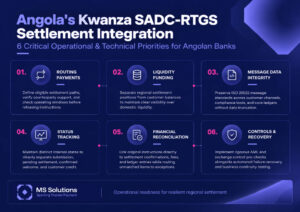
The Operational and Technical Issues Banks Should Address
Beyond formal participation requirements, banks should assess the following implementation priorities against their own architecture and transaction flows.
1. Routing Payments Through an Eligible Settlement Path
Adding AOA to a currency table is only one configuration change. Before releasing a payment, the bank should establish whether the receiving institution supports the intended route, whether the transaction is eligible and whether the relevant settlement window is open.
Routing decisions should consider currency, counterparty, service availability and funding. Unsupported instructions should enter a controlled exception process with a clear reason and an assigned owner.
This reduces the risk of accepting a customer instruction that the bank cannot execute through the selected route.
2. Funding Settlement Without Losing Visibility Over Domestic Liquidity
The participant guidance describes Angolan institutions funding their AOA settlement positions by transferring liquidity from the domestic Angolan RTGS through the agreed funding arrangement. Surplus funds may be returned through the approved process.
Treasury should therefore distinguish between the customer’s available balance and the bank’s available settlement liquidity. A funded customer account does not, by itself, demonstrate that the regional settlement position is sufficiently funded.
Useful controls include balance monitoring, funding thresholds, alerts for pending payments and reconciliation of transfers between domestic and regional settlement positions.
3. Preserving Payment Data Across System Interfaces
SADC-RTGS implemented its migration to ISO 20022 messaging standards in June 2024. Banks assessing AOA settlement should review their interfaces against the current participant specifications.
The implementation concern extends beyond generating a valid message. Customer channels, payment processing systems, compliance tools and the core ledger should preserve consistent party information, amounts, currencies and transaction references.
Banks should test for missing mandatory data, truncated remittance information and reference changes during message transformation. These issues can create repair work and make subsequent investigations harder.
4. Separating Submission, Settlement and Customer Credit
A successfully transmitted instruction should not automatically be recorded as a completed payment.
Banks should maintain distinct internal states for validation, submission, pending settlement, confirmed settlement, rejection and investigation. Customer notifications and accounting entries should use the appropriate confirmed event.
For example, if a connection fails after submission, the bank should investigate the original instruction before resending it. Duplicate detection and controlled retries help prevent a technical interruption from creating a second payment.
5. Reconciling the Payment with Its Financial Outcome
Operations teams need to connect the original customer instruction with the settlement confirmation, account movement, fees and ledger entries.
An effective reconciliation process should retain linked identifiers across these records and assign unmatched items to a responsible team. Exception reporting should show the amount, currency, age, reason and next action.
This allows the bank to distinguish between a payment that failed, a payment that settled but remains unposted internally, and a payment whose outcome still requires confirmation.
6. Applying Controls Before Release and Testing Recovery
The SADC-RTGS participation criteria require institutions to address anti-money laundering and exchange control obligations, demonstrate technical readiness and maintain business continuity arrangements.
Banks should translate applicable obligations into explicit release controls, approval rules and recorded decisions. Testing should include insufficient funding, unavailable counterparties, rejected messages, connection failures and recovery after an interruption.
Service design must also reflect the applicable settlement schedule. The AOA guidance ties settlement to SADC-RTGS operating hours and the relevant Angolan holiday calendar.
Rewiring the Stack: The MS Solutions Group Approach
For Angolan banks, connecting to new payment infrastructure starts with the systems already in place. MS Solutions Group’s modular SPARK platform supports this approach by helping institutions extend existing capabilities, adapt message formats and connect payment services to new processing and settlement requirements.
- SPARK Core Immediate Payment & Switching: Supports real-time processing and transaction routing across banking systems and payment networks. Its flexibility across communication protocols and processing workflows can help connect existing digital payment services to RTGS infrastructure, with integration configured around the target system’s requirements. Acts as an agile buffer between legacy core mainframes and national rails like EMIS and KWiK, guaranteeing 24/7 uptime and native ISO 20022 compliance.
- SPARK Acceptance Suite & SoftPOS: Turns standard NFC Android devices into certified payment terminals, slashing the capital expense of physical TPA hardware and pushing digital acceptance straight to informal market merchants.
- SPARK MPay & Retail Gateways: Pulls card rails, mobile wallets, and QR codes into a single merchant dashboard while providing unbanked users with P2P transfers and cardless ATM withdrawals.
- ISO Converter: Supports message conversion between existing systems and the formats required by the target infrastructure, including ISO 20022. This can help institutions prepare for earlier connectivity while limiting changes to their existing applications and supporting a phased transition.
- SPARK Trust & Intelligence Suite: Deploys real-time AI behavioral scoring to catch account takeovers and bad IBAN routings before settlement occurs, cutting fraud exposure by up to 30%.
- SPARK Clearing & Settlement: Supports the processing and control of clearing and settlement workflows, helping financial institutions manage transaction statuses, reconcile payment obligations and identify settlement exceptions. In a multi-currency regional environment such as SADC-RTGS, these capabilities can help banks strengthen operational visibility, improve reconciliation and support more reliable cross-border payment processing.
The approach supports gradual modernisation: adapt existing messages, establish the required connections, then extend payment services according to each institution’s operational priorities.
The Outlook Ahead
The mandate for Angolan financial institutions is unavoidable. Growth has outpaced legacy infrastructure. Institutions that continue to patch aging mainframes will watch transaction failure rates climb and compliance costs mount.
The banks that capture the next decade of growth won’t be those with the largest branch networks, but those flexible enough to integrate modern, modular layers like the SPARK platform, securing their operations in Angola and expanding seamlessly across the SADC corridor.
Speak with us about assessing your payment processing and settlement requirements.