For bank CIOs, heads of digital, and heads of payments in Ethiopia: February gave you a connection. It did not give you the programme behind it.
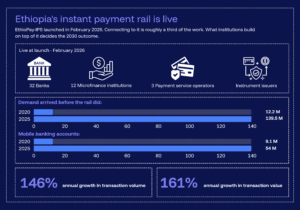
In February 2026, thirty-two banks, twelve microfinance institutions, three payment service operators and three payment instrument issuers went live on EthioPay-IPS. The rail supports account-to-account and wallet-to-wallet transfers, an interoperable QR standard, request-to-pay, alias-addressed payments, electronic mandates for recurring collections, a merchant portal, and same-day interbank settlement, in a market where settlement delays had been a standing complaint. It’s real infrastructure, delivered on schedule, identical for every institution that connects to it.
Behind the launch sits a target. The National Digital Payment Strategy 2026-2030 calls for thirty per cent of digital transaction volume to run on the instant payment system by 2030.
That target only makes sense against the base it’s measured from. Ethiopia went from 12.2 million mobile money accounts in 2020 to 139.5 million in 2025. Mobile banking accounts went from 9.1 million to 54 million. Volumes grew at roughly 146 per cent a year, and values at roughly 161 per cent. Digital payments were worth about 82 per cent of GDP in 2024; the strategy wants 750 per cent by 2030. This isn’t a market that needs convincing to go digital. It already has, mostly through wallets, mostly person-to-person, and mostly outside the new scheme.
A thirty per cent target over five years says less about what the rail can carry and more about everything a rail doesn’t do on its own. Connectivity arrived in February. Capability is still to be built, and the strategy is explicit that it’s expected, institution by institution.
-
Fraud and dispute management on an irrevocable rail
The strategy sets a fraud target of 0.0008 per cent of transaction value, with standardised national fraud reporting and faster dispute resolution. Now weigh that against what actually went live: instant, irrevocable, alias-addressed payments, the exact conditions that produce authorised push payment fraud, where the customer authorises the transfer under deception and no chargeback applies. A switch can pass along a fraud signal. It can’t run an issuer’s risk posture, case management, or dispute workflow. That exposure exists now, not in 2030.
-
ISO 20022 stops at the institution boundary
Universal ISO 20022 adoption is written into the strategy, and EthioPay-IPS speaks it. Most of the institutions behind it don’t; they run legacy cores and card estates on ISO 8583. Translation, enrichment and orchestration have to happen inside each institution, alongside a card estate that isn’t disappearing. It’s unglamorous work with a long lead time, and it sets the pace for everything downstream: richer data for fraud scoring, straight-through reconciliation, structured information a merchant can actually use. Treat it as a line item instead of a programme, and it will slow down everything else the institution has committed to.
-
Acquiring decides who wins the thirty per cent
Volume shows up when merchants have a reason to accept, and customers have a reason not to reach for cash. That means:
- Onboarding at scale
- Settlement timing a small trader can plan around
- Reconciliation that doesn’t require a spreadsheet
- Pricing that still works after margin
The interoperable QR standard exists. The acquiring capability that makes accepting it worthwhile for a merchant, largely, doesn’t yet exist. This is where the contest with established wallets gets decided.
Two more workstreams run on their own clocks:
- Identity. Linking every financial account to Fayda, the national digital identity scheme, by 2030. Onboarding is the more likely failure point here, not the transaction itself.
- Cross-border. The strategy commits to policy guidance on outbound retail transfers and, conditions permitting, a directive licensing banks, payment service operators, microfinance institutions and infrastructure providers to move low-value transfers.
There’s also a scheme-economics question no platform can answer on its own. Telebirr is the largest payment platform in the country by a wide margin, and the terms on which a dominant wallet joins a shared national scheme are among the hardest problems in scheme design anywhere:
- Pricing
- Who carries the float
- Who absorbs the cost when a transaction crosses estates
These are ecosystem questions, not vendor ones, and they’ll do a lot to decide whether thirty per cent turns out ambitious or conservative.
None of this is specific to Ethiopia. Any market standing up an instant rail alongside entrenched wallets, embedded legacy cores and a regulator working to a deadline ends up in the same place, and a growing share of the continent now fits that description. The national layer gets built once. The capability layer gets built dozens of times over, institution by institution, without disrupting what’s already running.
That second build determines the outcome. Institutions that treat the next twenty-four months as one orchestration programme, with fraud, standards translation, acquiring and identity sequenced and resourced together, will be the ones carrying volume by 2030. The rest will be connected, and nothing more.
Connecting legacy estates to modern schemes, and orchestrating what runs between them, is what MS Solutions Group does with banks and payment providers across the region.
Get in touch
If you are planning this work, we can talk through how other institutions have sequenced it, from fraud and standards translation through acquiring, identity and cross-border.