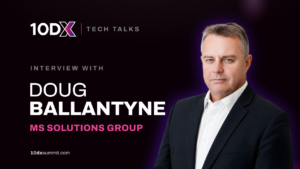
MS Solutions Group has spent over two decades building the payment infrastructure that most people never see, but every transaction depends on. With a growing footprint across more than 30 countries, the company’s SPARK platform sits at the centre of some of the most complex payment ecosystems in the world, connecting banks, processors, fintechs and retailers across issuing, acquiring, clearing, settlement and fraud management on a single end-to-end architecture. Recognised by the Financial Times as one of Africa’s fastest-growing companies, MS Solutions Group is quietly becoming the infrastructure partner of choice for institutions that need to modernise without the luxury of starting from scratch.
It is work that Doug knows from the inside. As Regional Director for Anglophone Sub-Saharan Africa, he has spent over 25 years at the sharp end of Africa’s payments transformation, from national switch deployments in Ethiopia and Malawi to payments innovation at leading fintechs and telcos across Kenya and digital banks in South Africa. Today, his focus is on the next layer of African payments infrastructure: solving fragmentation, bringing security, fraud and AML capability closer together, and building the cross-border interoperability that the continent’s growth demands.
We sat down with Doug to understand where African banking infrastructure is actually headed, and why the industry’s biggest gains are happening where nobody is looking.
Q: Across your work with banks, where are you seeing the most meaningful progress on digital transformation today and what is driving it?
The most meaningful progress is not happening at the customer interface layer it is happening underneath it, in the infrastructure that most people never see. The banks making real gains right now are the ones that have stopped treating digital transformation as a front-end problem and started treating it as a rails problem.
Three pressures are arriving simultaneously and forcing the issue. Regulatory mandates CBK’s National Payments Strategy, PAPSS connecting 19 central banks, mandatory ISO 20022 migration are creating hard timelines that commercial priorities alone never generated. Mobile money competition has set a customer expectation for real-time, always-on service that legacy batch-processing cores simply cannot meet. And rising capital adequacy requirements are forcing institutions to demonstrate operational resilience, not just report it.
The banks making progress are the ones that recognised these pressures are not sequential they are simultaneous. That is forcing a more honest conversation about payment infrastructure than the industry has had in a long time.
Q: What practical steps are helping banks build more efficient, responsive and connected digital operations?
Three things and the most important one is rarely the most discussed.
The first is progressive abstraction rather than replacement. Banks that are modernising without operational disruption are doing it by building a bridging layer that speaks ISO 20022 to the outside world and ISO 8583 to the legacy core underneath simultaneously, in real time, with a complete audit trail throughout. You do not shut down. You do not run parallel systems indefinitely. You migrate the interfaces progressively while the core continues operating. It is flight deck replacement while the plane is in the air, and the banks doing it well have planned the sequencing carefully.
The second is settlement and reconciliation automation. This is consistently the first place operational risk concentrates when transaction volumes scale particularly at the integration point between mobile money rails and traditional banking infrastructure. The banks seeing efficiency gains have invested in closing that seam first, before it becomes a regulatory finding.
The third is mobile money interoperability. Across East and West Africa, the banks that have connected properly to mobile money ecosystems not just via basic USSD integration but with genuine real-time straight-through processing and clean settlement have seen material improvements in customer retention and operational cost. The ones that have not are losing ground every quarter.
Q: What is one outcome you have delivered for a banking client that the wider industry should be paying attention to?
The outcome is the successful migration of a bank’s payment operations to ISO 20022 live, in production, without a single day of downtime while the legacy core remained untouched and fully operational throughout.
The reason the industry should pay attention is not the technical achievement, though that matters. It is what it proves commercially: that the binary choice between replacing everything and doing nothing is a false one. Banks have been told for a decade that core modernisation is a multi-year, high-risk, board-level gamble. What this demonstrates is that the payment layer can be fully modernised ISO 20022 compliant, real-time capable, cross-border ready without triggering that risk at all. The core is a dependency, not an obstacle.
As PAPSS expands, as CBK’s Fast Payments System comes online, and as correspondent banking relationships increasingly require ISO 20022 compliance as a condition of access, that proof point becomes more relevant to more institutions every month. The banks that have already done this work are not just compliant they are competitively positioned. The ones still waiting are compressing their own runway.
This interview is part of the 10DX Tech Talks series conversations with the leaders shaping the future of intelligent banking, to reach out to our experts, contact us now.