For compliance and financial crime leaders in most Nigerian financial institutions, the contrast is clear. While customer-facing functions have modernised over the years, compliance has remained a collection of parallel processes, functional in isolation but fragmented in practice.
The Central Bank of Nigeria’s Baseline Standards for Automated AML/CFT/CPF Solutions, issued in March 2026, represent a deliberate intervention in that gap, and the scale of the problem they address is significant. Nigeria processed over ₦600 trillion in electronic transactions in 2024 alone. At that volume, the limitations of manual compliance are not a design preference; they are an arithmetic reality.
The Architecture Problem
What the standards diagnose, implicitly, is an architecture problem that has accumulated quietly across the industry. Customer due diligence, sanctions screening, transaction monitoring, and regulatory reporting have historically been implemented as discrete controls rather than components of a unified system. Each layer may function adequately on its own. Together, they produce coverage gaps, data inconsistencies, and response latencies that sophisticated financial crime is well-positioned to exploit.
The clearest illustration of this dysfunction is the false positive problem. AML false positive rates across the industry typically range between 85% and 95%, meaning the vast majority of compliance alerts do not represent genuine financial crime risk. The consequence is not simply inefficiency; it is a systematic misallocation of analyst capacity, where compliance teams spend most of their time clearing noise rather than investigating real risk. Global AML compliance costs are estimated at over $206 billion annually, with much of that expenditure directed at managing alert volumes rather than catching criminals.
The CBN framework reframes the question. Rather than asking whether each control exists, it asks whether they are integrated, whether information flows coherently across the full customer lifecycle in a way that enables early identification of risk rather than retrospective detection of harm.
A Shift in Regulatory Expectation
The standards reflect a broader evolution in how regulators are thinking about compliance effectiveness. The emphasis is shifting from documentation to operationalisation, from having policies in place to demonstrating that those policies produce consistent, auditable outcomes at scale.
This shift carries institutional weight beyond the regulatory text itself. Nigeria spent over two years on the FATF grey list before securing its removal in October 2025, a period during which Nigerian transactions faced elevated scrutiny globally, correspondent banking relationships came under pressure, and the reputational cost of compliance gaps became tangible.
Nigeria’s seven largest banks faced a combined $10.7 million in regulatory fines in 2024 alone. The CBN’s baseline standards are, in part, a structural response to that experience, an effort to embed the reforms that earned FATF delisting into the permanent operating architecture of Nigerian financial institutions.
Automation is no longer positioned as an efficiency measure. At modern transaction volumes, it is a baseline requirement. Patterns that would take a human analyst days to detect can be flagged by a trained machine learning model in seconds.
The Data Residency Imperative
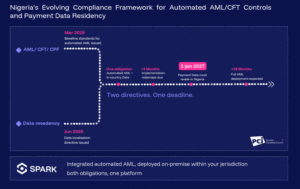
The CBN’s AML framework does not stand alone. In June 2026, the Central Bank issued a separate but directly related directive on data localisation, signed by the Director of the Payments System Supervision Department. The directive requires all financial institutions, fintech firms, mobile money operators, and payment service providers to store payment transaction data within Nigerian borders by 1 January 2027. The stated rationale to strengthen oversight, improve transparency, and reduce concentration risks reflects the same regulatory logic as the AML standards: that effective supervision requires proximity and control over the data that underpins it.
Read together, the two instruments create a coherent and mutually reinforcing obligation. Any institution relying on a cloud-native or foreign-hosted compliance platform that processes Nigerian payment data offshore will face a structural conflict with the January 2027 deadline, regardless of the quality of its AML algorithms. Compliance with one instrument without compliance with the other is not compliance at all.
What This Means in Practice
Institutions that fail to meet the baseline standards or that operate AML solutions in a manner that results in ineffective controls may be subject to remedial directives, administrative sanctions, and penalties. The compliance deadline is not abstract: institutions are required to submit implementation roadmaps within three months of the circular’s issuance, with full deployment expected within 18 months.
Compliance programmes built on legacy architectures where data must be reconciled manually, where case management sits outside the transaction monitoring workflow, face structural limitations that incremental improvements are unlikely to resolve. The more instructive question is not whether existing systems meet the letter of the standards, but whether they are designed to scale with the risk environment. Institutions that have invested in integrated compliance platforms are better positioned not because technology substitutes for judgment, but because it creates the operational conditions under which better judgment is possible.
For compliance leaders operating across African markets, Nigeria is the leading edge, not the exception. Comparable automated-AML and data-residency expectations are taking shape across the continent; each built on the same logic: compliance infrastructure must keep pace with the payment infrastructure it governs. The institutions that solve it for Nigeria first will be the ones ready when their other regulators follow.
Platforms built for integrated, AI-driven monitoring have been shown to cut false positive rates by as much as 70 to 80%, freeing compliance teams to focus on the alerts that actually matter.
At MS Solutions Group, our SPARK platform was built around precisely this principle: compliance as a unified, automated ecosystem rather than a layered stack of isolated tools. From fraud prevention and sanctions screening through to transaction monitoring and regulatory compliance, SPARK is designed to give institutions the visibility and control that frameworks like this demand. Critically, SPARK is deployed on-premise, within the institution’s own jurisdiction, sovereign by design, not as an afterthought. That architecture means institutions do not face a choice between AML compliance and data residency compliance. One platform answers both halves of what the CBN now requires.
The deadline is fixed; the runway is not. If you are responsible for AML or financial-crime compliance within the Nigerian payment ecosystem, the time to map your readiness against the CBN’s March and June 2026 instruments is now, not in the final quarter before January 2027. Talk to our team about CBN-readiness assessment and see exactly where your current architecture meets the standard and where it does not.